- Free worldwide shipping, tracked and insured
- Same day dispatch, customs handled
- Certificate of analysis for every batch
- Adipose lipolysis research in rodent models
- Fat-oxidation and energy-expenditure studies
- hGH fragment structure-activity research
Overview
What is AOD-9604?
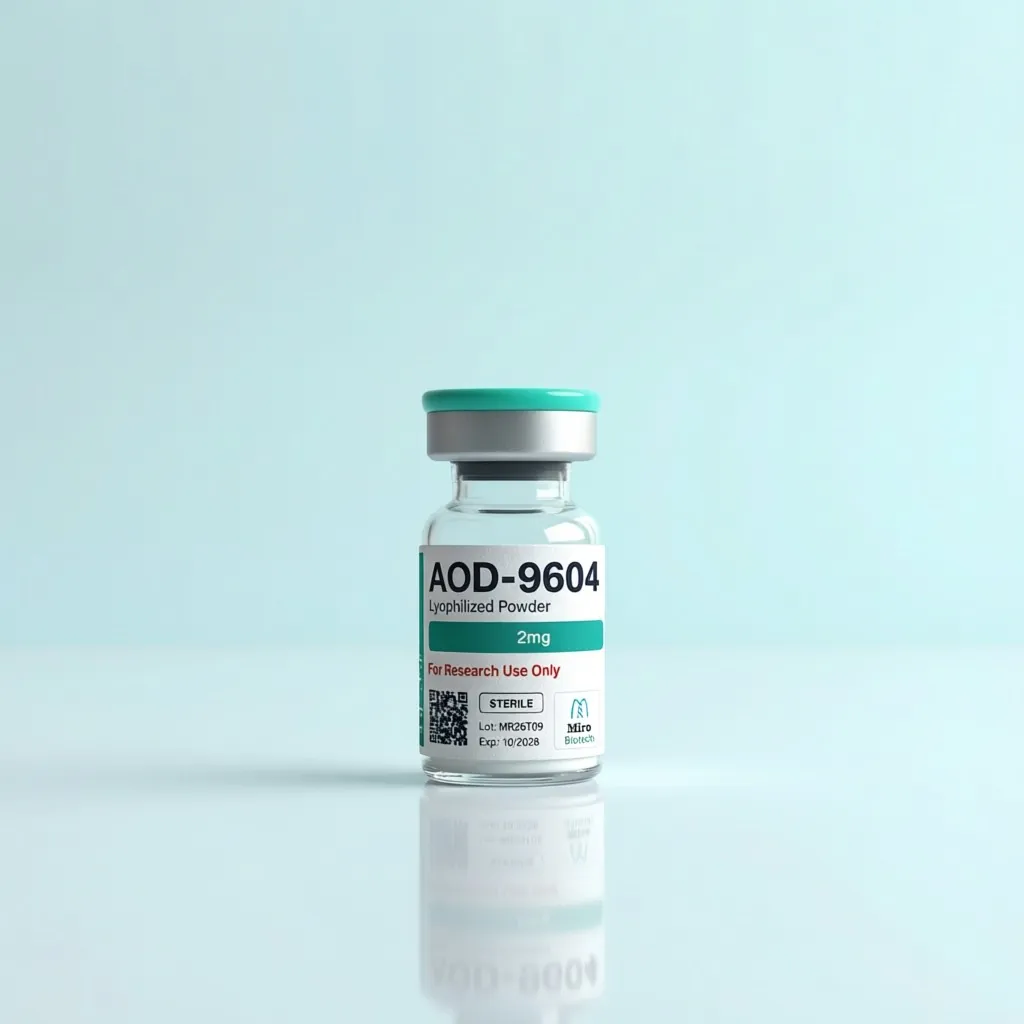
AOD-9604 is a synthetic hexadecapeptide derived from the C-terminal region of human growth hormone, designed to isolate the lipolytic domain of hGH from its growth-promoting signalling. It is used as a research compound in studies of adipose lipolysis, fat oxidation, and energy expenditure in rodent models, and as a reference material in anti-doping method development. Supplied for in-vitro and laboratory research use only.
Mechanism in research
How AOD-9604 is studied
In published research, oral AOD-9604 given to obese Zucker rats for 19 days was associated with less than half the weight gain of controls and higher adipose lipolytic activity, with no loss of insulin sensitivity on a euglycaemic clamp, unlike intact hGH. In ob/ob mice, chronic treatment was associated with reduced weight gain and higher in-vivo fat oxidation without hyperglycaemia, and the peptide did not compete for the hGH receptor or induce proliferation in a hGH-receptor cell line. Treatment restored repressed beta-3 adrenergic receptor expression in obese mice, but chronic effects were absent in beta-3 receptor knockout mice, so the authors concluded the lipolytic action is not directly mediated through that receptor. In humans, six placebo-controlled trials reported no change in IGF-1 or glucose metabolism; the 12-week 1 mg/day oral arm lost 2.6 kg versus 0.8 kg on placebo without dose dependence, and the 24-week phase 2b did not show significant weight loss. These findings describe the published literature; the compound is supplied here strictly as a research reference standard.
Reported targets & pathways
- Adipose lipolysis and fat-oxidation pathways (rodent models)
- Beta-3 adrenergic receptor expression (associated, not direct)
- No binding to the hGH receptor
- Acute energy-expenditure regulation (rodent)
Reference data
AOD-9604 specifications
- Sequence
- Tyr-Leu-Arg-Ile-Val-Gln-Cys-Arg-Ser-Val-Glu-Gly-Ser-Cys-Gly-Phe (YLRIVQCRSVEGSCGF), Cys7-Cys14 disulfide
- Classification
- Synthetic hGH C-terminal fragment (hexadecapeptide), lipolytic domain
- Appearance
- White lyophilized powder
- Solubility
- Soluble in water and bacteriostatic water
- Molecular formula
- C78H123N23O23S2
- Molecular weight
- 1815.1 g/mol
- Purity
- 99.36%
- CAS number
- 221231-10-3
- PubChem CID
- 71300630
Research applications
Where AOD-9604 is used in research
Areas of study described in the published literature. Listed for research reference only.
Rodent obesity models
Used in obese Zucker rat and ob/ob mouse studies of weight gain, fat oxidation, and glucose handling.
Lipolysis assays
Studied in adipose tissue preparations for lipolytic activity and glycerol release.
hGH fragment structure-activity
Applied in work separating the lipolytic domain of growth hormone from its receptor-mediated growth signalling.
Anti-doping method development
Serves as a reference material for LC-MS detection and in-vitro metabolism studies of growth hormone fragments.
Selected research
Published studies on AOD-9604
Peer-reviewed references for further reading. Findings describe in-vitro and animal research; mechanisms and outcomes in humans are not established.
Hormone Research · 2000
Reported that obese Zucker rats given oral AOD9604 for 19 days gained less than half the body weight of controls, showed higher adipose lipolytic activity, and kept normal insulin sensitivity on a euglycaemic clamp, unlike animals given intact growth hormone.
Endocrinology · 2001
Reported that 14 days of treatment reduced body weight and fat and restored repressed beta-3 adrenergic receptor expression in obese mice, while chronic effects were absent in beta-3 receptor knockout mice, leading the authors to conclude the lipolytic action is not directly receptor-mediated.
Journal of Endocrinology and Metabolism · 2013
Summarised six randomised, double-blind, placebo-controlled trials in 925 subjects using oral and intravenous AOD9604 for up to 24 weeks, reporting no effect on serum IGF-1 or carbohydrate metabolism, no anti-drug antibodies, and an adverse-event profile indistinguishable from placebo.
Clinical Pharmacology and Therapeutics · 2010
Reviewed the AOD9604 clinical programme, noting a 2.6 kg versus 0.8 kg placebo weight change in the 12-week 1 mg/day arm without dose dependence, and that development was terminated in 2007 after a 24-week trial in 536 subjects failed to show significant weight loss.
Quality
Independently verified, batch by batch
Tested every batch
Every batch of AOD-9604 is independently analyzed by a third-party laboratory before it is released.
Independently verified
Identity and purity are confirmed by an independent third-party laboratory. This batch is verified to 99.36% purity.
Certificate of analysis
Every batch is independently tested with a certificate of analysis. A digital COA is available on request.
Reviews
What researchers say about AOD-9604
reorder went the same way
tbh by the second lot theres not a lot left to say, the ob/ob mice did the same thing both times, fat oxidation up and glucose flat like the 2001 paper. tromsø in 7 days this time, vials fine
Left with the accountants next door
We run an LC-MS screen for growth hormone fragments and wanted a second reference material alongside the one we already use. The AOD itself is fine. Retention time and the main fragment ions line up with our existing standard, which is all we asked of it. The lost star is for the handover. The courier left the parcel with the accountancy firm two units down on the business park, no card, nothing on the tracking beyond delivered, and it was Monday before their receptionist wandered over with it. A lyophilised peptide spending the weekend in someone else's post tray is not ideal, even if the cakes looked untouched. Aberdeen, six days on paper, so the slow bit was the last fifty metres.
Explanten svarade som väntat
Vi tog 5mg till Jönköping för en lipolys modell på fettvävnad från råtta. Glycerolet i mediet gick upp mot kontroll ungefär som i de gamla studierna, inget dramatiskt men det syns. Fem dagar, flaskorna hela. Frågade om disulfidbryggan kontrolleras per batch och fick ett konkret svar dagen efter, ingen mall.
straightforward
dundalk in six days and the glycerol release off the rat fat explants came up over vehicle like the papers say, nothing else to report
passt für die zucker ratten
wir haben das 10mg für eine kohorte fetter zucker ratten genommen, 19 tage wie in der alten arbeit. gewichtszunahme liegt unter den kontrollen und der blutzucker hat sich nicht bewegt, also ungefähr das was publiziert ist. mainz in fünf tagen. mehr kann ich nach einer kohorte noch nicht sagen
Mass came out at 1815
We bought the 5mg as an in-house reference for a growth hormone fragment method, so the first thing it saw was the mass spec. Deconvoluted mass sat at 1815 and change, which is the free peptide with the disulfide closed. HPLC was one main peak, nothing we could pin on a reduced form. After that we stopped checking and just used it. Rennes in eight days.
AOD-9604 FAQ
Related Products
GLP-3 (RT)
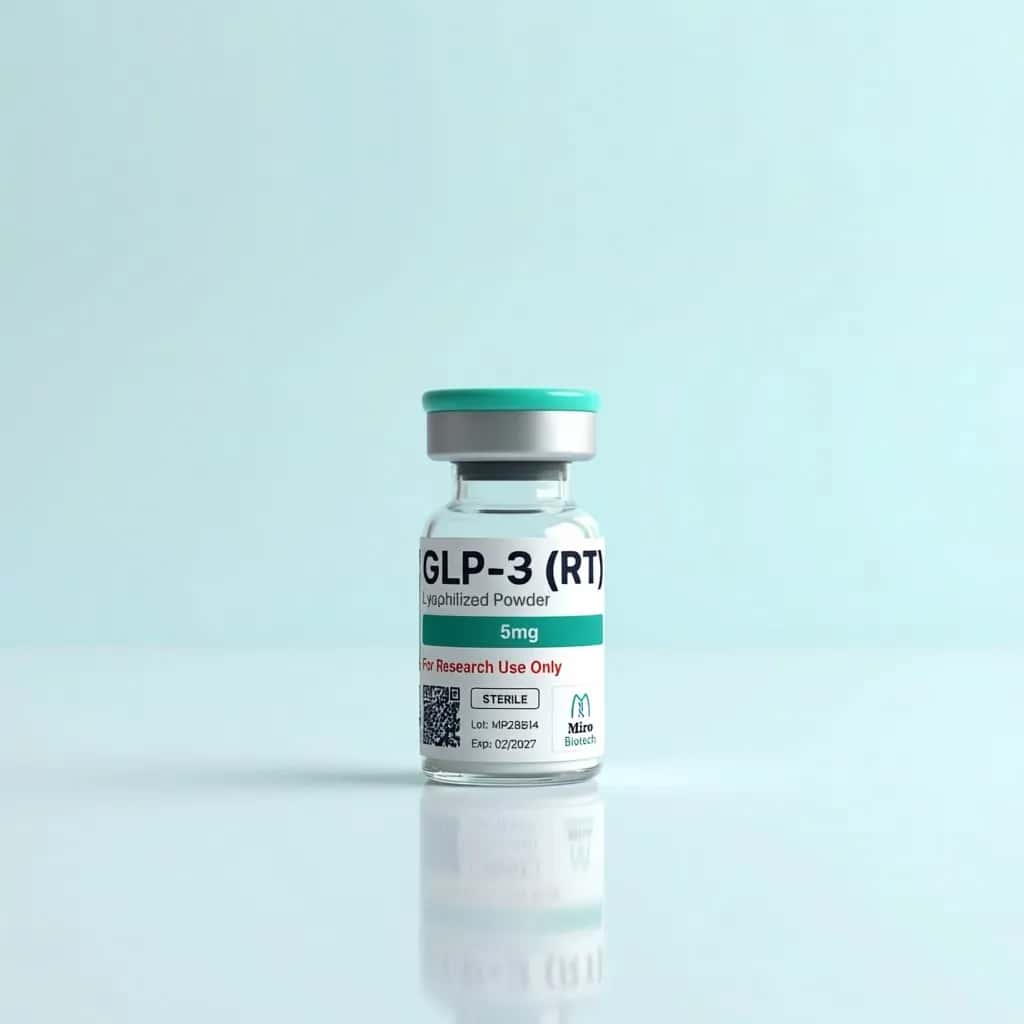
99.62% pureTriple agonist peptide targeting GLP-1, GIP, and glucagon receptors for metabolic and obesity research.

Tesamorelin
99.20% pureGHRH analogue that stimulates growth hormone release, researched for metabolic regulation and body composition studies.

MOTS-c
99.79% pureMitochondrial-derived peptide studied for metabolic regulation, insulin sensitivity, and cellular homeostasis.

CJC-1295 (No DAC)
99.60% pureHigh-purity (99.60%) CJC-1295 without DAC research peptide. GHRH analogue for growth hormone secretion, pulsatile GH release, and metabolic pathway studies.